Friday, October 30, 2009

Module 6 - Field Notes

Every week has so many things that are interesting and add more pieces to the puzzle of how we got here both in terms of art, and as people. I find the study of art to be like the study of the Bay Area. They are both huge multi-cultural stews made up of the best (mostly) of every culture.
Cubism. I found that Leger's * The City did a great job of illustrating Cubism and how human vision plays such a role. *"Our eyes shift and scan a subject; our minds combine these fragments into a whole." The fragments of expected urban sights absolutely do add up to a complete picture in my mind.

Some of the Futurist's work is so modern and fits right in today. Maybe because it is now the future. ;-) I love the work of Ardengo Soffici in particular. * Bitszf + 18...... is so dynamic and exciting.

The fact that futurists considered typography to be a *"concrete and expressive visual form..." reminded me of an idea I had around the problems that occur with email. Email is so often taken wrong. Everyone I know has misunderstood or been misunderstood via email to include etudes. I think that all word processing programs should have some font choices that would universally be accepted as: sarcastic, loving, humorous, obsequious etc. That would solve so many problems and could be my retroactive contribution to the futurist movement.

Lucian Bernhard was the rare person in all of these writings. Most artists worked with another when they came up with a new direction for art. That makes sense as it is the discourse between us that sparks excitement, discussion and new ideas and hence the beginning of any movement. Lucien was a young boy with only an eye for what was really of consequence in (advertising) design. His works are so clean and modern. His use of negative space adds to his spare style and it works so well even today.

Some people are born with an innate talent and it's really a miracle when one finds what it is and makes it their avocation.

John Heartfield certainly chose a fitting name for himself. I am sad to say that an exhibit of his posters would still be "Unfortunately Still Timely". I hope that changes in my lifetime. It does show what an impact artists can make in the world raising consciousness and awareness for their causes. Or just making us stop for a minute and reflect. There has actually been a musical written based on his life. It was done in 2000 at Towson University near Baltimore. The photos of the participants seem so happy and weirdly at odds with this most serious man of whom we have been reading. This example of his work, Hurrah! The Butter is all Gone, is very arresting. Look at the detail all the way down to the swastikas embedded in the wall treatment.

Translation I was able to find:
"Hurrah, the butter is everything! Ore always " a realm strongly made; Butter and schmalz at the one most people made fat"  via babelfish.yahoo.com. This example is a classic case of what we as designers are taught about getting to the essence of the statement we want to make and working from there. What could be at the soul of the statement Heartfield was making than this:


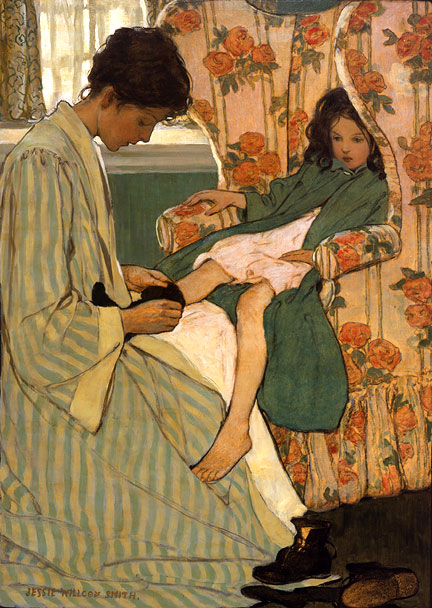
At the back of all of the developments in art and society is the beginning stirrings of women's rights.What stands out for me as always are the stories of women who were passionate enough to buck expected traditional roles to create the lives they wanted for themselves. That said, the story of Jesse Wilcox Smith, Violet Oakley and Elizabeth Shippen Green leapt off the page and sent me into research mode.

This is a work by Wilcox Smith:


An example of Shippen Green's work:

One of a series of murals Violet Oakley's painted for the Pennsylvania Capital:

Oakley, Shippen Green and Wilcox Smith were three of the most important illustrators of their time.
It was fortuitous that they found each other. The support they provided one another was undoubtedly considerable.


They spent almost 15 years together sharing a house, work, friendship and at least one love affair. They lived together with a woman called Henrietta Cozens, in the role of house manager of sorts, in a house called the Red Rose Inn and became known as the Red Rose Girls. There is a biography of that name written by a San Jose State Illustration professor named Alice A. Carter.
Side Note: Astonishingly (to me anyway) the book is not available in any of the area libraries including MLK library in San Jose which is the library for SJ State. I ordered the book but it is not due to arrive for 2-3 weeks. If it comes while still class is still in session, I'll report back.
UPDATE: I received the following message back from Ms. Carter this morning, Tuesday:
Dear Robin,
Thanks for your interest in "The Red Rose Girls." The book is available on Amazon or at the MLK library in special collections. Since you are interested in female artists, you might like to go to the following site and read about how the book is being adapted for a Broadway musical.
Best Regards,
Alice Carter
The women met in 1897 in an illustration class taught by the very famous illustrator Howard Pyle.

Jesse didn't begin drawing until she was 20 whereas Elizabeth was the daughter of an illustrator.
Violet Oakley began as an illustrator but is most remembered as one of the greatest American muralists. The Violet Oakley site is gorgeous and I highly recommend you visit especially if you have an interest in web design. Her site contains more biographical information than is found for the other two. Violet studied at the Acadamie Montparnasse in Paris before settling in Pennsylvania. At the age of twenty-four, she was commissioned to create both a stained glass window and mural for The Church of All Angels in NYC. The resulting art works are considered her most lauded work and made her North America's first professional female artist. I could find no usable images that did that did mural justice although the web site cited above is close.

I have a special place in my heart for photography as it is my hobby/passion.
Man Ray was an interesting artist with many modes of creation. He is best known for his surrealist photography:

He was quite the womanizer and a closet sexist wearing his feminism on his chest more because it was expected than anything else. He met his match in 1929 in the guise of a high-spirited American woman called **Lee Miller. Lee was the subject of a research paper I wrote which I would happy to share with anyone who might want to read it. Teaser: Once WWII consumed Europe, Lee became a war photographer in for Vogue magazine in London and was taking a bath in Hitler's bathtub as he was dying. She was a really interesting woman in the art world. Many of Man's photographs feature Lee, or parts of Lee. Together they accidentally (re)invented the "solarization" technique featured in this photograph and many others:

It is lifted from a great surrealism and design page I found created by John Coulthart's.
Solarization seemed to have been rediscovered over a period of years. There is evidence that Degas used a solarized negative to create his famous ballerina paintings. The movement is so clear in the negative.


The surrealism movement is another example of the small number of artists that share a vision and together change the world of art.

Cocteau
A surrealist film maker called Jean Cocteau gave Lee her only acting job in one of his (very) strange films, The Blood of a Poet.
A few of Lee's more well known surrealist photographs from her website:

The Shadow of the Great Pyramid

 
 Portrait of Space

Exploding Hand
Surrealism gave art humor and excitement and the element of surprise to art. What a gift!

* From our textbook

Monday, October 26, 2009

Module 5 - Field Notes

Art and politics have always been the closest and strangest, of bedfellows.
Artists as activists have been very successful in spreading dissent. Their work is sometimes obvious but oftentimes it is more furtive and requires the viewer/reader/listener to delve deeply to puzzle out the meaning. Once that happens, word travels fast.

The thought of the amazing artist Kitagawa Utamaro being so heart broken after his incarceration and torture that he lost his devotion to his art is the down side of an artist using his gift in the service of his beliefs. Naming names of some of his subjects was a political statement he must have felt he had to make and it cost him everything.

It isn't just a historic occurrence. Robert Mapplethorpe's photographs continued to cause an uproar as recently as 1998 when police in Britain confiscated a book of his photographs and threatened it with burning . Luckily, in the end that wasn't the case but just the idea that things like this can still happen is almost inconceivable. Mapplethorpe's photographs came about after the Stonewall riots of 1969 New York when gay men were actively fighting to be recognized as people with rights. Mapplethorpe's work put that struggle in the forefront with his erotic gay images and the news they garnered.
An aside: An excellent documentary of Mapplethorpe and his lover, the art dealer and amazing character Sam Wagstaff is Black White + Gray. http://www.blackwhitegray.com/ Fascinating!

This is a really well done site.
There is a page that highlights an exhibit called The Design of Dissent at New York's School of Visual Arts. The first link doesn't work. Use the second. Here are some images that really spoke to me:


Inspiration
 There are so many works of art that have been in my life peripherally without me actually being conscious of them. Two Japanese woodblock prints have been displayed in my cousin's house all of my life. They are Katsushika Holusai's 'Red Fuji' and 'In the Hollow of the Wave off the Coast of Kanagwa". I never thought about who created them. It's interesting to learn of the profound affect that national isolationism had on art history. It's hard to imagine what Japanese art of that era would have become had the country been open to input from all over the world. I love it the way it is. The simplicity of some images of nature especially, is breathtaking.


My guess is that Gustav Klimt's masterpiece "The Kiss" is one of the most imitated artworks of all time. I have known teenage girls who have loved this work so much. It captures romantic dreams so completely. These are some examples of his work interpreted by artists on the web:


 A hero of mine is Julia Morgan (1872-1957) an amazing architect and a woman waaaay ahead of her time. She was a student of the Arts and Crafts movement and was very much influenced by Frank Lloyd Wright's mathematical approach to the visual in architecture. She is best known as the architect who created Hearst Castle for William Randolph Hearst. Her own designs more typify her love for both Arts and Crafts and California Mission styles of design. She was an amazingly gifted person who followed a very tough road to get to her place in history.


In closing, I'd like to tell you about a strange coincidence. I was reading the Alphabet and the Goddess - la,la,la,la - and when I grabbed my bookmark, something about it looked familiar. I don't know where it came from and I don't remember seeing it before but below you will see a photo of it. It has on it an illustration by Alphonse Mucha. 


Here's an on-line gallery of the Mucha Museum

Tuesday, October 20, 2009

Module 4 - Field Notes

There is so much that amazes and surprises me as I read the text.
-William Leavenworth actually had customers send a drawing of one letter and he would create an entire font based on it. In 1834! Wow!
-In one year shortly after daguerreotypes were somewhat perfected, though with limitations, one being the long processing required to print, 5000,000 were made in Paris!
-Louis Prang seemed to me to be a marketing genius! He created markets for products that hadn't even existed before. He was really ahead of his time. He used the new chromolithography to it's absolute fullest to make his ideas reality. His imprint is still a huge part of our culture in the form of greeting cards. Art supplies and self taught art education materials were also his ideas along with some of the very first art journals. He would have fit right in with the entrepreneurship spirit that exists today. He may have given Larry Ellison a run for his money. What a fascinating person.
-John Bufford was another innovative thinker and designer. His drawing talent, use of color and his original thinking beget beautifully realized tonal illustrations.On top of his considerable illustration skills he was one of the first to really consider the complete set of design aesthetics required to create a fully realized vision. The poster he created for the Swedish Song Quartet with the caps over the heads of the soloists reminds me of the Amazon logo:

-William Morris really created a life based on his philosophy and was able to surround himself with what he considered beautiful. I watched a documentary about Valentino the haute couturier and it made me think of Morris. Valentino had the means to create a life of beauty for himself, beauty that he created and very much controlled in every facet of his life. Not many are so lucky to have the ability to control their world to such a degree. Morris had a hand in so many different design concerns that he really did visually control his every day life.


These people left us a considerable legacy of design philosophy, innovation and craftsmanship that is truly awe inspiring.


The part that illustration played in the early days of advertising prompted me to look at an old September 1925 issue of National Geographic for examples. I was surprised at the number of ads that used both photography and illustrations such as this example for Whitman's Chocolates. Click to view a larger version and read the copy as it is really something!

This example shows the use of hand lettering along with photography. It seems a quaint mix of what was then old and new:

Can you believe that in the last years of the 1800's popular magazines carried 1oo pages of advertising in a single issue?? That may actually be worse than today.


The schism between typographers philosophy was born as early as the Victorian era as purists complained about attention getting visuals as opposed to idea that type should "serve the text first and otherwise stay in the background".


Jessica Hische is an illustrator whose work I admire. She tries to create a new drop cap every day. She's mostly successful at meeting that challenge. I think creating an artwork every day is a wonderful way to keep your personal creativity flowing:
Jessica's blog:

Monday, October 12, 2009

Module 3 - Field Notes

While reading this week's assigned chapters I was struck by the similarity of displaced worker then and now. With the advent of printing, scribes, once revered for their talent were displaced by the printing press. They tried to stage and revolt but were not supported by their local government. Some used their skill to teach writing to the newly literate.

This made me think back on my early career as a drafter and illustrator. I had great skill and my drawings were used in engineering and marketing for a variety of uses. The advent of CAD drafting put an end to that career. Engineers began creating their own drawings and the role of even a CAD drafter is very limited. With any technological advance there are obsoleted positions and workers have to adapt as best they can.


Nowadays there isn't much that seems out of the realm of possibility for the human mind to accomplish but it certainly wasn't always that way.

Witchcraft seemed to be a common justification to many things that seemed unexplainable at first. Johann Fust was forced to explain Gutenberg's printing process to the French who upon seeing the number of bibles printed and their conformity raised the cry of witchcraft. That event sparked the writing of numerous books centered around the dissatisfaction with the limits of human knowledge. There have always been great thinkers and the printing press gave us the gift of their knowledge as it still does today.


I'm not surprised that censorship started with the church. Church in my opinion being synonymous with government and politics. 
Those in charge, whether elected or appointed, always want to try to control their constituents in some way. The church must have been very fearful once they had to share literacy as it opened the door to free speech.


Reading about the advent of the printed word makes me want to share a book with you. One of my prized possessions is an 1893 book of photographs from the Columbian Exposition; otherwise known as the Chicago World's Fair. It is interesting to look at the publishing info after reading about the  history of printing.


I love this statement from the bottom part of the title page,
"Authors of "Shepp's Photographs of the World, " the most famous book of modern times.


I take no credit for their grammar. :-)


The Alphabet Versus the Goddess


Thanks Kent, for recommending this book. It's an exceedingly informative and insightful book from the very beginning.
Firstly I am sad that such an original thinker has dies. By all accounts the author, Leonard Shlain, was an amazing scholar, brain surgeon, father and communicator. I would have loved to have had the opportunity to attend a lecture given by such a passionate person.


This book is as instantly enthralling as a great novel. For someone without any formal education in evolution or the acquisition of language, the book provides a no nonsense explanation of how our brain evolved to our current incarnation.
Mr. Shlain explains his hypothesis of the loss of the Goddess culture as a result of our acquisition and employment of written language over image based communication, resulting in a shift to the differently evolved left brain. From that point, we have never looked back.


Mr. Shlain explains how men developed a more linear approach to thought processes and women a more broad approach to the world and to problem solving. Historically that has been the case. What about the current state of our social evolution now that we are acting "as if" we are all the same. Women can and should do what men do and men should be more like women. Are we forcing a change in our evolution much like the acquisition of language did?
Is that how it happens? We know that other cultures don't have these same gender blurring so who wins out?


In the book, "The End of History and the Last Man", the author, Francis Fukuyama, among many other theories, posits that the spread of Western Capitalist culture would end the need for physical war and as such the need for the ultra manliness needed for a warrior. It's an interesting theory. I can't help but wonder what would happen should Muslim Fundamentalism or for that matter Christian Fundamentalism be the overriding force.


Consider the proliferation of psychiatric drugs given to women who are too emotional or the stimulants given to boys to counteract their more male tendencies. Is this another step toward creating one sex?


I see so much posturing and competition between some of my married / committed friends relationships. I believe it is because of the blurring of genders. I find it painful to watch. It does seem different in the next generation. My younger friends don't seem to mind who makes the most money and since they pick up the kid(s) at daycare and dinner on the way home and have a housekeeper in once a week there isn't the same conflict.


There is a lot to think about and I find it fascinating.


People of the Book by Geraldine Brooks

 
Another fascinating book that I'm reading is also apropos is the fictional story of a book conservator and her journey to uncover secrets of a real historic Hebrew text called the Sarajevo Haggadah. The codex that inspired this book is believed to have been created during Spain's golden age in the mid 14th century but that is conjecture as there is no colophon.


The Sarajevo Haggadah is a Jewish religious text illuminated that sets out the order of the Passover Seder. The fictional conservator uses clues found in her rebinding of the ancient book such as an insect wing, a hair and wine stains to try and determine the past history of the book. It's a fascinating read and I recommend it highly.


http://en.wikipedia.org/wiki/Sarajevo_Haggadah


Friday, October 2, 2009

Module 2 - Field Notes

Reading about man’s need and desire to communicate and the long rich history of visual communication is a real gift. If we were still out hunting and gathering, we wouldn’t have time for this studying thing.


Trying to understand what it must have been like to feel the deep need to communicate takes me back to my oldest son’s early childhood. Aaron is ‘moderately-severely’ deaf. I remember how hard he would work to try to get his point across before he and I learned to sign when he as 18 months old. As the vast majority of people can’t sign Aaron has become a master of non verbal communication. You do not want to try and beat him in charades.


Aaron works in a grocery store and has to communicate with hearing people all day long and although it’s easy for him to communicate easy concepts (pictographs) and ideas (ideographs), trying to communicate deep feelings has caused Aaron real pain and profound frustration. It is a very painful thing for a parent to witness.


When I think of man first finding himself with that need to communicate, I think it must have been like that. I imagine that frustration would have been an important driving force behind our resolve to learn to communicate.


From the vantage point of our evolutionary place, it is incomprehensible to think of our lives without language. It wouldn’t be possible. If there were no language, no communication, we wouldn’t be able to peaceably coexist. Most of the problems we have in our world today are caused by a lack of communication at a deep level and about some of the very same things that drove us to communicate in the first place such as spirituality, economics, ownership and ideals.


To me, one of the most surprising things about even the earliest forms of visual communication is the methodical and artistic nature given to even the earliest forms. It shows how man’s intelligence really evolved in the face of requirement and opportunity.